
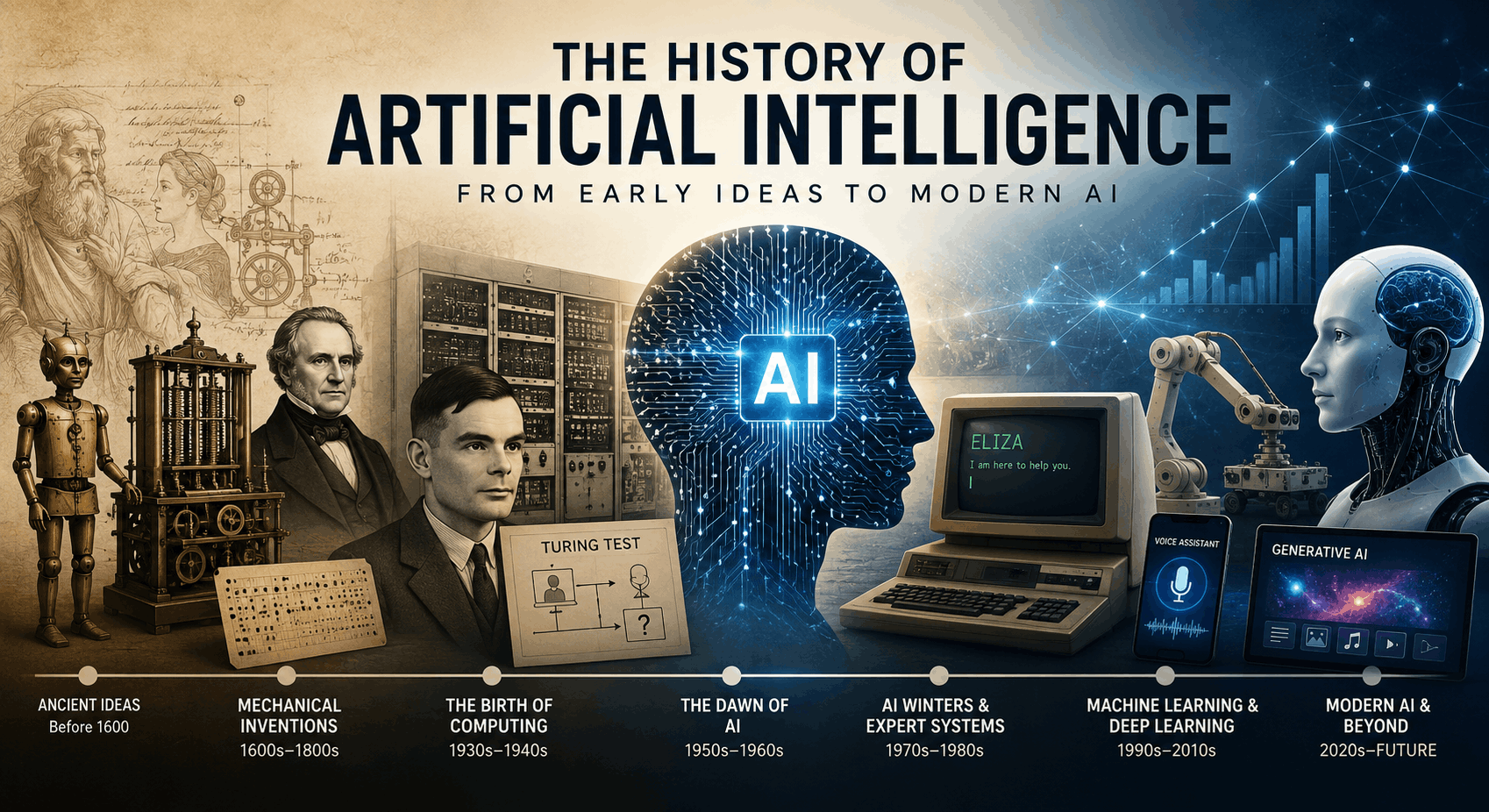
The History of Artificial Intelligence is one of the most fascinating stories in modern science and technology. It combines human imagination, mathematical discovery, and relentless innovation across decades of research. Although today’s AI tools seem revolutionary, their roots stretch back much further than many people realise. Early philosophers imagined intelligent machines long before computers even existed. Since then, researchers have transformed those ideas into systems capable of learning, solving problems, and even creating original content. Understanding this journey helps us appreciate both today’s achievements and tomorrow’s possibilities.
The Early Ideas That Inspired Intelligent Machines
Long before electronic computers appeared, people dreamed about creating machines that could imitate human thinking. Ancient myths featured mechanical servants and artificial beings capable of performing complex tasks. While these stories belonged to legend rather than science, they demonstrated humanity’s enduring fascination with artificial intelligence.
During the seventeenth and eighteenth centuries, philosophers began exploring whether reasoning could follow logical rules. René Descartes, Gottfried Wilhelm Leibniz, and others believed that thought might be expressed through mathematical principles. Their work laid important intellectual foundations for future computer science.
Meanwhile, inventors created increasingly sophisticated mechanical devices. Although these machines could not think independently, they demonstrated that automation could replace certain human tasks. Consequently, the idea of intelligent machines slowly shifted from fantasy towards scientific possibility.
The nineteenth century brought another major breakthrough. Charles Babbage designed the Analytical Engine, often considered the first concept for a programmable computer. Ada Lovelace recognised its remarkable potential and suggested that machines might eventually manipulate symbols beyond simple calculations. Although their machine was never completed, their vision inspired generations of researchers.
The Birth of Modern Computing
The twentieth century changed everything. Advances in mathematics, electronics, and engineering created the conditions needed for intelligent computing systems.
Alan Turing became one of the most influential figures in this transformation. During the 1930s and 1940s, he developed theoretical concepts that defined modern computation. His famous Turing Machine demonstrated that a universal computer could solve countless different problems through programming rather than specialised hardware.
Later, Turing proposed an important philosophical question: “Can machines think?” He introduced the Turing Test as a practical way to evaluate machine intelligence through conversation. Although researchers still debate its limitations, the test remains one of the most recognised concepts in artificial intelligence.
At the same time, early digital computers emerged during World War II. These machines processed information faster than humans could perform manual calculations. While they lacked genuine intelligence, they proved that computers could execute increasingly complex instructions with impressive accuracy.
As computing power expanded, scientists became more confident that machines might eventually imitate human reasoning.
The Dartmouth Conference Changed Everything
The History of Artificial Intelligence reached a defining milestone in 1956 during the Dartmouth Summer Research Project on Artificial Intelligence.
John McCarthy organised the conference alongside Marvin Minsky, Claude Shannon, and Nathaniel Rochester. More importantly, McCarthy introduced the term “artificial intelligence,” giving the growing research field its official name.
Researchers gathered with extraordinary optimism. Many believed that human-level intelligence might be achieved within a few decades. Their confidence encouraged governments, universities, and research organisations to invest heavily in AI development.
Early programs demonstrated promising abilities. Some solved mathematical problems, while others proved logical theorems or played simple games. Although these systems operated within narrow environments, they suggested that computers could perform tasks previously reserved for humans.
Therefore, the Dartmouth Conference marked the official beginning of artificial intelligence as an independent scientific discipline.
Early Successes and Growing Optimism
Throughout the 1950s and 1960s, AI research expanded rapidly. Scientists developed programs that appeared surprisingly intelligent for their time.
One notable example was the Logic Theorist, created by Allen Newell and Herbert Simon. It successfully proved mathematical theorems, demonstrating that computers could perform symbolic reasoning.
Soon afterwards, researchers introduced the General Problem Solver. Rather than solving only one specific challenge, it attempted to apply general reasoning techniques across multiple problems.
Joseph Weizenbaum later created ELIZA, one of the earliest conversational computer programs. Although ELIZA relied on simple pattern matching instead of genuine understanding, many users believed it displayed real empathy.
Robotics also advanced during this period. Researchers built machines capable of navigating controlled environments and manipulating physical objects. These developments strengthened confidence that intelligent robots might eventually become reality.
As enthusiasm increased, funding flowed into universities and government laboratories worldwide.
The AI Winters Slowed Progress
Despite early excitement, researchers soon discovered that intelligence proved far more difficult than expected.
Computers lacked sufficient processing power, memory remained extremely limited, and available data was scarce. Furthermore, many ambitious promises failed to produce practical results.
Consequently, governments and investors reduced financial support during the 1970s. This period became known as the first AI Winter.
Although research continued, progress slowed considerably. Scientists focused on solving smaller, more achievable problems instead of pursuing fully intelligent machines.
The 1980s brought renewed optimism through expert systems. These programs stored specialised knowledge from human experts and applied logical rules to specific industries such as medicine and finance.
However, expert systems also revealed important weaknesses. They required constant maintenance, struggled with unfamiliar situations, and lacked genuine learning abilities.
When expectations again exceeded results, funding declined for a second time. Another AI Winter followed, reminding researchers that technological progress rarely follows a straight path.
Machine Learning Changed the Direction
The History of Artificial Intelligence entered a new chapter as researchers shifted their attention towards machine learning.
Instead of programming every possible rule, scientists developed algorithms capable of learning from examples. This represented a major philosophical shift.
Machine learning enabled computers to improve performance through experience rather than relying entirely on handcrafted instructions.
Several factors supported this transformation. Computing hardware became dramatically faster, digital storage expanded rapidly, and the internet generated enormous amounts of data.
Researchers also refined statistical techniques that allowed algorithms to recognise patterns within large datasets.
Consequently, computers became increasingly effective at recognising handwriting, detecting spam, recommending products, and translating languages.
These practical successes attracted fresh investment from businesses eager to apply AI to real-world challenges.
The Rise of Deep Learning
Deep learning revolutionised artificial intelligence during the early twenty-first century.
Inspired by simplified models of the human brain, artificial neural networks became far more effective as computing power increased. Researchers could now train networks containing many layers, allowing them to discover complex relationships within massive datasets.
Graphics processing units, originally designed for video games, dramatically accelerated AI training. At the same time, cloud computing provided researchers with unprecedented computational resources.
As a result, deep learning transformed fields including image recognition, speech recognition, natural language processing, and autonomous driving.
Major breakthroughs followed quickly. Computers surpassed human accuracy in certain image classification tasks. Voice assistants became increasingly reliable, while translation systems improved dramatically.
Moreover, AI systems mastered complex games such as Go, chess, and poker using advanced learning techniques.
These achievements demonstrated that modern AI could solve problems once considered impossible.
Artificial Intelligence Enters Everyday Life
Today, artificial intelligence influences millions of people without them even noticing.
Search engines use AI to deliver relevant results. Streaming platforms recommend personalised entertainment. Smartphones improve photographs through intelligent image processing.
Banks rely on AI to detect fraudulent transactions. Hospitals assist doctors with medical imaging analysis. Manufacturers optimise production through predictive maintenance.
Meanwhile, businesses automate customer support using intelligent chatbots. Online retailers personalise shopping experiences based on browsing behaviour.
Generative AI has introduced another significant transformation. Modern systems create text, images, music, software code, and videos from simple prompts.
Consequently, artificial intelligence has become an essential part of daily life across education, healthcare, transportation, finance, entertainment, and countless other industries.
Ethics, Challenges, and the Future
While artificial intelligence offers enormous opportunities, it also presents significant challenges.
Researchers continue addressing issues involving privacy, bias, transparency, security, misinformation, and responsible development.
Governments worldwide are developing regulations that encourage innovation while protecting public interests. Likewise, technology companies increasingly invest in AI safety research and ethical guidelines.
Another important discussion concerns employment. Although automation may replace certain repetitive jobs, it will likely create new careers requiring creativity, technical expertise, and human judgement.
Education also plays a vital role. People who understand artificial intelligence can adapt more successfully as technology continues evolving.
Looking ahead, AI will probably become even more integrated into healthcare, scientific research, climate modelling, personalised education, and business operations.
Nevertheless, human oversight will remain essential. Artificial intelligence works best when it complements human intelligence rather than replacing it entirely.
Why This Journey Matters
The History of Artificial Intelligence demonstrates that technological revolutions rarely happen overnight. Instead, they emerge through decades of experimentation, collaboration, setbacks, and persistence.
Every breakthrough built upon earlier discoveries. Philosophers inspired mathematicians. Mathematicians influenced computer scientists. Computer scientists created algorithms that now power modern AI systems used around the world.
Although today’s artificial intelligence appears remarkably advanced, researchers continue exploring new frontiers. Future innovations may transform industries in ways that are difficult to imagine today.
Understanding this remarkable history provides valuable perspective. It reminds us that today’s achievements were once considered impossible, while tomorrow’s breakthroughs are already beginning in research laboratories across the globe.
As artificial intelligence continues evolving, its story remains unfinished. The next chapter will depend not only on technological progress but also on the choices humanity makes about how these powerful tools should be developed and used. By learning from the past, society can better shape an intelligent future that benefits everyone.
FAQ
1. Who first introduced the term artificial intelligence?
John McCarthy introduced the term “artificial intelligence” during the Dartmouth Conference in 1956, which officially launched the field as an academic discipline.
2. Why did AI research experience periods of slow progress?
Research slowed because computers lacked sufficient processing power, available data was limited, and early expectations greatly exceeded technological capabilities.
3. What made machine learning different from earlier approaches?
Machine learning allowed computers to learn from data instead of relying entirely on manually programmed rules, making systems more adaptable and accurate.
4. How has AI become part of everyday life?
Artificial intelligence supports search engines, voice assistants, online shopping, fraud detection, navigation, healthcare, entertainment, and many other daily services.
5. What does the future hold for intelligent technologies?
Future developments will likely improve healthcare, education, scientific research, automation, and creative tools while increasing the importance of responsible and ethical development.